
Can You Optimize a Human?
You can optimize a machine. I don't think you can optimize a person and I'm starting to wonder what we turn into when we try.

Somewhere in the last decade, optimize stopped being a word we used for engines and spreadsheets and started being a word we use for ourselves.
My sleep is a score now. My morning is a protocol. My focus is a metric with a graph attached. Rest got rebranded as “recovery,” which is just work in a bathrobe, and even doing nothing has been colonized… now it’s “active recovery,” and you’re supposed to be doing it correctly…
At its core, optimization culture treats human beings like machines. A computer can be optimized. An algorithm can be optimized. But can a human being? What does an optimized human even look like? Is it someone who wakes at 5 a.m., tracks every calorie, measures every step, monitors every hormone, and spends every waking moment pursuing self improvement?
And if so, to what end?
What is the purpose of being human? Is it to become the most efficient version of ourselves possible? Is life simply a series of metrics to maximize and flaws to eliminate? Or is there something essential about being human that resists optimization altogether?
I want you to really sit with the actual word for a second, because I think we’ve been using it without listening to it. Optimize. That’s a machine word. You optimize a system, a process, an engine, a line of code. But now (or maybe for a while) we started aiming it at ourselves, at our bodies, our hours, our one strange life, without pausing to ask the obvious question.
Can you even do that to a person? And if you could, what on earth would you get?
What does optimization really need? To optimize anything, you need two things first: a metric, and a goal. You have to know what you’re measuring, and you have to know what “better” means. You can optimize a toaster because a toaster is for something — you want browner bread, faster, using less power, and every one of those is a number you can chase. The toaster has a purpose, handed to it from outside, by whoever built it. That’s what makes “better” a coherent idea.
So when someone says they’re optimizing themselves, the only honest response is: optimized for what? Toward what target? Set by whom?
And the second you ask that, the whole thing starts to get shaky. Because to run the optimization, you have to pick what to measure and picking what to measure means deciding what to ignore. What optimization ignores about a human being is, more or less, everything that makes one worth being. It can track your sleep but not why you lay awake. It can count your steps but not where you were walking or who you were thinking about. It can log your protein and your heart rate variability and your screen time, and none of that touches the part of you that laughs at a joke, or forgives someone, or stands in a doorway feeling suddenly, wordlessly sad for no reason at all.
The optimized self is just the part of you a machine could have kept. Everything else gets left off the dashboard because it wouldn’t fit in a cell.
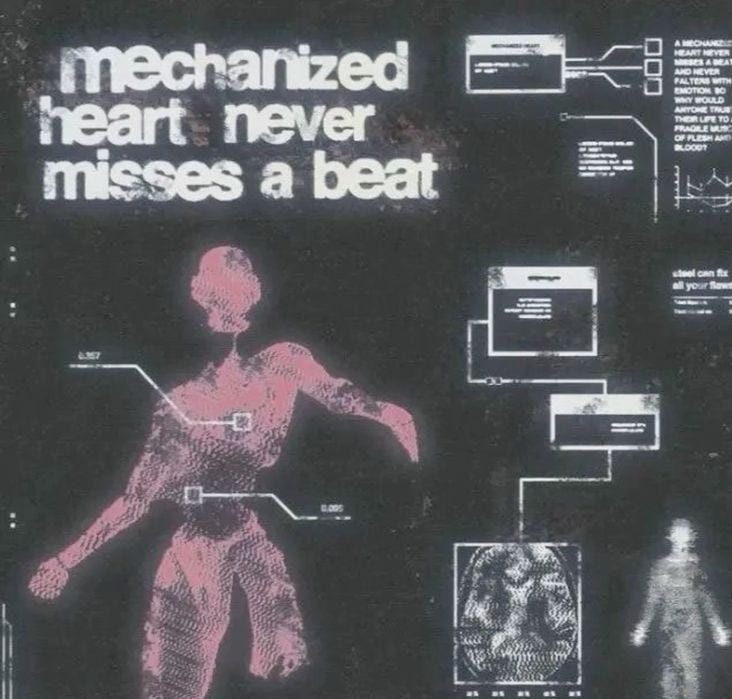
If this sounds like a stretch, look at the people at the very top of the trend, because they’re not being metaphorical. They actually believe the body is an engineering problem, and they’re spending fortunes trying to solve it.
Jeff Bezos is the best known backer of Altos Labs, which launched a few years ago with around three billion dollars, one of the biggest debuts in the history of biotech. Sam Altman personally bankrolled almost the entire seed round of a longevity startup whose stated mission is to bolt ten extra years onto the human lifespan, and which is now chasing a multi-billion-dollar valuation without a single clinical result to show. Peter Thiel funds a foundation whose literal slogan is making ninety the new fifty. Their premise is simple and total: aging is a bug, death is a defect, and a body is a machine that a smart enough engineer should be able to fix.
The retail version of this is a man named Bryan Johnson, who has turned himself into the mascot of the whole worldview. He’s spent something like two million dollars a year tracking over a hundred biomarkers, on a project whose actual mantra is Don’t Die. He talks about his body the way a fund manager talks about a portfolio. But even people inside longevity medicine warn that his method carries a specific hazard: the anxiety of obsessive measurement, watching your own numbers all day until the watching itself eats you. He may have the biomarkers of a teenager, but by his own descriptions the days sound like a sentence being served. The lights are all green. It’s genuinely not clear anyone’s home.
That’s the reduction of the entire trend, sitting right there in the flesh. You can optimize a human body toward the numbers of an eighteen-year-old and still, apparently, hollow out the human who has to live inside it.
This might sound amusing at first, and it’s easy to joke about, but the psychology behind it is far less funny. A machine can eventually be finished, perfected, and optimized for its intended purpose. A human being cannot. There is no final version of a person, no point at which we are complete.
The philosopher Byung-Chul Han has the clearest read on this. His argument, roughly, is that we’ve traded one kind of society for another. The old one ran on prohibition, external rules, a boss, a you may not. The new one runs on possibility, on you can, you should, you could always be doing more. It sounds like freedom. It’s the opposite. Because when you’re your own boss and your own brand and your own lifelong renovation project, the person doing the exploiting and the person being exploited are the same person. There’s no factory owner to unionize against. There’s just you, at 9pm, feeling like you should probably be optimizing something.
A toaster has an optimal state. Reach it and you stop; the job’s done. But there is no optimized enough for a human, because we were never built toward a spec, so the finish line just keeps reversing away from us. That’s the engine of the anxiety. What actually makes me angry is that optimization culture takes problems that are structural and collective and hands them back to you as personal failures.
You’re not tired because work is extractive and rent is deranging and the ground keeps shifting under everyone’s feet. No, no. You’re tired because you haven’t dialed in your magnesium. Your sleep hygiene is sloppy. You skipped the cold plunge. The whole framework subtly relocates enormous, shared, systemic exhaustion into your own body and blames you for having a “discipline” problem. It privatizes suffering. And then, having convinced you the problem is you, it sells you the fix(we love a good capitalism scheme).
But strip all that away and you’re still left with the question that actually keeps me up, score or no score.
What is an optimized human? What does she do all day? What is she for? A machine gets its purpose from its maker… that’s the only reason “better” means anything for a machine. We have spent our entire history as a species arguing about what humans are for, and the answers people died for were things like love, or God, or truth, or beauty, or each other. The optimization era answers the oldest question in philosophy with a shrug: you’re for becoming a more optimized version of yourself. WHAT does that even mean.
Optimized toward what? Toward being more optimized. It’s a snake eating its own tail and calling it discipline. There’s no destination in it! No point you’re moving toward, just endless tuning of a machine that was never actually built for anything. It asks you to treat yourself as an instrument, a means to your own future output, forever, and it never once tells you what the output is for.
Love is inefficient. Grief is inefficient. Art is inefficient. Wonder is inefficient. Long conversations, daydreams, mistakes, detours, and moments of pure joy rarely contribute to productivity, yet they are often the experiences that give life its richness and meaning. Perhaps the problem is that we have confused living well with performing well. In our pursuit of optimization, we risk reducing ourselves to machines… forgetting that the most valuable parts of being human cannot be measured, tracked, or improved upon.
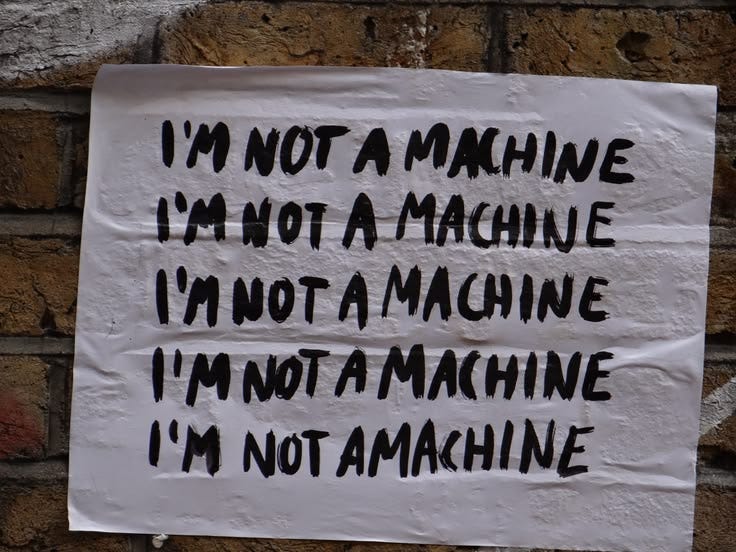
I think to be human is to be partly unfinished, partly unknowable even to yourself. A mystery you live rather than a problem you solve. A machine has no interior; a person is almost entirely interior. The detours, the wasted years, the terrible hobby, the changed mind, the afternoon that produced nothing, I promise you those aren’t bugs in the system. That’s where the life actually happens. You cannot debug a human being without deleting them.
So no. I don’t want to be optimized.
Bring back inefficiency. Bring back long walks that lead nowhere. Bring back conversations with no agenda. Bring back hobbies you’ll never monetize and never master. Bring back getting lost, changing your mind, wasting an afternoon. Bring back the sacred disorder of being human before we optimize the last of it away.
fuck yeah. it's great. i love this lens on optimization.
great writing! "You can optimize a human body toward the numbers of an eighteen-year-old and still, apparently, hollow out the human who has to live inside it." is a killer line. i honestly had to learn this firsthand through grief - i thought if i did certain things or survived certain milestones i could have a timeline that i'd understand as to when i felt better, but i realized that you really can't control how your emotions fluctuate and the only way out is to experience them and understand them. i think we often create these goals because emotion and humanity can be hard to understand and goals feel quantifiable and achievable. but you're right that the experience of being human is supposed to be messy, and that it's easy to get lost in striving for something when it's really the journey that makes it meaningful. great article!